In our previous article - The Great AI Divide: Navigating Risk and Disruption in Private Equity - we explored how Artificial Intelligence is reshaping risk and value creation in private equity, examining the distinct threats facing AI-native and AI-adapter portfolio companies, the erosion of traditional competitive moats across key sectors, and why shifting from a software-first to a data-first mindset is essential to building resilient, defensible value in an AI-driven landscape.
In this article, we build on that foundation by exploring the concept of a “data moat” — created when a business owns and continually enriches proprietary data that competitors cannot easily access or replicate. In an era where AI capabilities are increasingly commoditised, this has become one of the most powerful and sustainable sources of long-term differentiation.
Rather than relying on product features alone, organisations with strong data moats use insights from customer interactions, workflows, and long-term usage to drive smarter automation and sustained performance improvement.
When combined with deep operational integration and customer trust, data moats form a durable foundation for competitive advantage. For private equity operating partners, the focus must shift from what a product does to how effectively its data protects value, strengthens defensibility, and compounds returns over time.
What This Article Explores:
-
Why data moats are becoming the most durable form of competitive advantage
-
How proprietary data flywheels create compounding differentiation
-
The importance of trust, auditability, and explainable AI in regulated sectors
-
How niche specialisation, regulation, and workflow integration create defensive barriers
-
What private equity operating partners should prioritise when evaluating AI defensibility
The Primacy of the Proprietary Data Flywheel
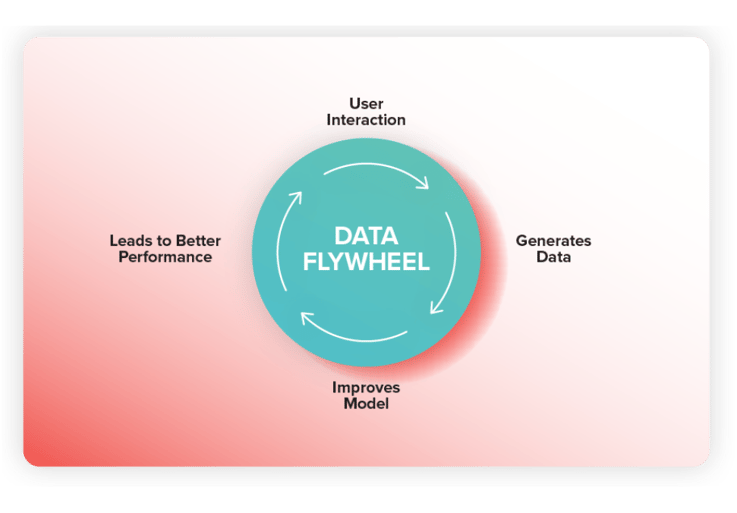
The ultimate goal is the “data network effect,” or data flywheel. This is a virtuous cycle where a product's use generates unique, proprietary data that no competitor can access. This data is used to train and improve the underlying AI model, which in turn creates a superior product that attracts more users. For an operating partner, the focus must be on ensuring portfolio companies have a mechanism where product usage generates unique, proprietary data that directly improves the core AI model, creating a widening gap with competitors.
 Trust, Auditability, and "Explainable AI"
In high-stakes verticals like finance, law, and healthcare, trust is a fragile prerequisite for adoption. We prioritise Explainable AI (XAI) because a company that offers a clear, auditable trail for why its AI made a specific recommendation gains a powerful advantage over opaque black box systems. In these sectors, auditability is not a feature but a core requirement for a defensible go-to-market strategy.
Strategic Defensive Layers
Beyond data and trust, assets can build defensibility through:
-
Niche Market Specialisation: For those facing threats from generalist platforms, the most viable defence is achieving undisputed market leadership in a specific vertical, building models trained on domain-specific data and regulation that generalist AIs cannot match.
-
Regulation as a Competitive Barrier: Strategic compliance with complex regulations, such as the EU AI Act, can be turned into a "compliance moat". Proactively achieving and marketing adherence to these stringent standards creates a significant barrier to entry for new competitors.
-
Deep Workflow Integration: When a product becomes the core System of Record (SoR) for a customer's critical business processes, the switching costs become immensely high. Creating customer lock-in through deep embedding remains a critical strategy.
By combining these layers, PE firms can ensure their portfolio companies are building an enduring competitive edge that withstands the pace of modern innovation.
Closing Thoughts
In the AI era, durable advantage comes not from features alone but from proprietary data, deep workflow integration, and trusted, explainable systems. For private equity firms, the focus must shift toward building technology foundations that protect value and compound advantage over time.
In our next and final article of the series, we explore how to evaluate these moats during a deal, examining the signals that distinguish durable advantage from short-term differentiation.
How Codurance Can Help
Codurance partners with private equity firms and their portfolio companies to unlock and accelerate enterprise value through AI-driven technology, while proactively identifying and mitigating technical risk.
Across the investment lifecycle, we help businesses modernise legacy platforms to enable AI-ready platforms, implement scalable and resilient architectures, and build high-performing engineering capabilities through Software Craftsmanship. The outcome is faster delivery, lower technical risk, stronger operational performance, and a more resilient, exit-ready asset.
If you'd like to find out more, get in touch with us today.
Frequently Asked Questions
1. What is a data moat in the AI era?
A data moat is a form of competitive advantage created when a company owns and continually enriches proprietary data that competitors cannot easily access or replicate. As AI models and tools become increasingly commoditised, the real differentiation comes from the quality and uniqueness of the data used to train and improve those systems over time.
2. Why are traditional software moats weakening in the AI era?
Traditional software moats based purely on product features are weakening because AI capabilities are becoming widely accessible. Many companies can now build similar functionality using the same AI tools. As a result, defensibility increasingly comes from proprietary data, deep workflow integration, and specialised domain expertise rather than features alone.
3. How can private equity portfolio companies build durable competitive advantage with AI?
Portfolio companies can build durable advantage by developing proprietary data flywheels, embedding their platforms deeply into customer workflows, and building trust through transparent and explainable AI systems. Combined with regulatory compliance and domain expertise, these factors help create long-term defensibility and sustained enterprise value.
About the Author
Lee Sanderson has over 30 years of experience in software development, spanning roles from Developer to hands-on CTO, and is a polyglot programmer with deep experience across modern technologies. He enjoys helping teams move faster by streamlining development through XP, Agile practices, and continuous delivery, while maintaining clean architecture and high-quality code. He also enjoys spending time exploring how AI will shape the future of software engineering.