AI adoption delivers measurable value when you treat it as a business capability rather than a series of experiments: one built on strong data foundations, clear product thinking, connected company context, sensible governance and rigorous measurement. Our work with clients at Codurance over the past two years has made this clear.
Most organisations have already proven that AI tools can do impressive things. The harder question is how to scale them across teams so they improve the numbers your business actually cares about. In this article, AI adoption means the move from isolated pilots and individual tool use to consistent, governed use of AI across your engineering, product and operational teams.
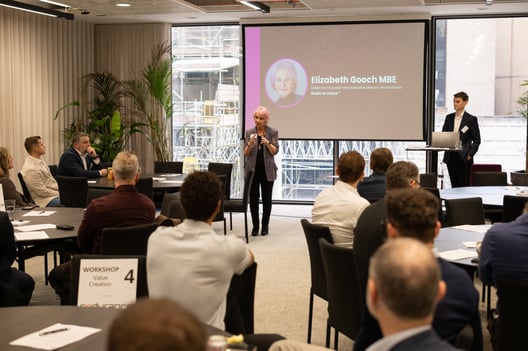
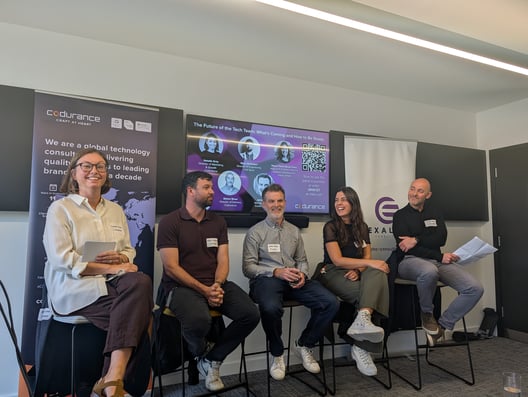
The insights below come from a recent Codurance event, in partnership with Manchester Digital where technology leaders from Kellonova, Peninsula, and Capsule CRM shared what has and hasn't worked as they move AI from experimentation into everyday delivery. Each section answers a question you are likely to be asking if you are responsible for AI adoption in your own organisation.
What this article explores:
- How to get your teams adopting AI tools consistently and safely
- Why AI doesn't replace good product thinking
- The data and knowledge foundations you need before AI can scale
- How to take an AI proof of concept into production
- How to measure the impact of AI on your business
- How to prove a return on your AI investment, including in private equity backed businesses
How do you get your teams to adopt AI tools consistently and safely?
You get consistent AI adoption by centralising your tooling, training your people and agreeing clear guardrails, so teams can experiment safely without unnecessary restrictions. When every team picks its own tools and its own rules, you end up with pockets of enthusiasm, duplicated spending and no shared view of what is working.
Leaders at the Manchester event described four things that make adoption stick:
- Centralised tooling. A single, approved set of AI tools makes it easier to support teams, manage cost and compare results.
- Training and a common language. When everyone understands the same terms and techniques, ideas spread faster and people can learn from each other's experiments.
- Clear frameworks, policies and guardrails. Good guardrails give teams confidence to try things. They should protect your customers and your data, not slow every experiment down.
- Treating AI as an enabler. AI works best when it supports your people and strengthens your processes. Using it simply to remove existing processes or roles tends to create resistance and risk.
Think of it like introducing a new member to your team. You wouldn't hand them access to everything and walk away. You would give them context, standards and someone to check their work. Codurance took a similar approach to building our own AI capability, scaling knowledge through communities of practice, an AI Champions group and dedicated training exercises.
Does AI replace the need for good product thinking?
AI doesn't replace good product thinking, and it makes weak product decisions more expensive. You still need to be clear on what you are building, why you are building it and whether it solves the right problem for your customers.
AI can help your teams build more. Building more is not the same as moving faster or creating more value. If your priorities are unclear, AI simply helps you produce the wrong thing in less time.
Before you put AI to work on a product or feature, it helps to answer three questions:
- What customer or business problem does this solve?
- How will you know it has worked?
- What will you stop doing, or do differently, as a result?
This matches what Codurance has seen in its own engineering work: AI acts as an amplifier, so strong practices get stronger and weak ones get weaker. Faster code generation also doesn't guarantee faster delivery, because the bottleneck often moves to review, testing or release instead.
What foundations do you need before AI can scale across your organisation?
To scale AI, you need strong data foundations, good documentation and connected organisational context. Without them, AI tools have little to work with and every new use case starts from scratch.
Leaders at the event highlighted three foundations in particular:
- Quality data. Your data needs to be accessible, consistent and trustworthy. Siloed data and fragmented reporting make scaling much harder.
- Documentation. Clear records of how your systems, processes and decisions work give AI the context it needs to produce useful output.
- A connected "company brain". Bringing your knowledge and context together in one connected place can make AI significantly more useful. Instead of answering questions from a narrow slice of information, it can draw on what your whole organisation knows.
Think of a sat nav working from an out-of-date map. It will still give you confident directions, but they won't always get you where you need to go. AI working from incomplete or disconnected information behaves in much the same way.
The bar is also rising as organisations move towards AI agents. Data that is accurate enough to report on may not be accessible, real-time or trustworthy enough for an agent to act on, which is why Codurance's Data and AI Readiness Assessment looks at your data engineering and governance alongside your AI use cases.
How do you take an AI proof of concept into production?
An AI proof of concept (POC) reaches production when it combines ambition, strong product discipline and sponsorship from across the organisation, not just from technology. A POC that only your engineering team believes in rarely survives the move to a live product.
The leaders in Manchester pointed to four ingredients:
- Ambition. Aim the POC at a problem that matters enough to justify the investment needed to scale it.
- Product discipline. Define the problem, the users and the success measures before you start building.
- Broad sponsorship. Bring sales, marketing and, where possible, customers into the process early. Their support helps the work get prioritised, funded and adopted.
- Managed expectations. AI can accelerate development, but your existing codebase, architecture and operational realities still shape how quickly you can go live.
That last point is easy to underestimate. A POC built in isolation can move quickly because it avoids the constraints of your real systems. Production can't. Gartner finds that by the end of last year, at least 50% of generative AI projects were abandoned after proof of concept. That is why the platform underneath matters too.
Croner, part of Peninsula Group, shows what this looks like when the pieces come together. Codurance had already built a Databricks-powered platform that structured and standardised Croner's tax content, so the team could move straight to building Croner Intelligence, an AI virtual assistant, rather than resolving data quality issues first. It launched on time and on budget, and reached almost twice its projected user adoption within the first 10 days. You can read how the team did it in the Croner case study.
How should you measure the impact of AI on your business?
Measure AI against meaningful business KPIs, and keep evaluating its output over time. The question to ask is how AI affects your quarter and your wider business, not whether a tool looks impressive in a demo.
Useful measures depend on where you are using AI, but they usually fall into a few areas:
- Engineering productivity, such as lead time for changes, time in review and how often you release.
- Quality and stability, such as incidents per change and the amount of rework.
- Time-to-information, such as how quickly people can find the answer or data they need.
- Commercial outcomes, such as revenue, cost to serve and customer retention.
The potential gains are real. One engineering example shared at the event pointed to a potential 30x improvement, even though adoption in that team had started cautiously. Results like this only carry weight when you can show the before and after.
That is why a baseline matters. Compare your own figures from before AI adoption ramped up with the figures since, rather than relying on industry benchmarks alone. Codurance sets out which delivery measures to baseline before you scale AI further, including time in review, rework and incidents per change.
How do you prove a return on your AI investment?
You prove AI ROI by deciding how you will measure value before you start, then tracking it over the long term. One phrase captured the mood of the room in Manchester: "if you can't measure it, don't do it."
The conversation has shifted. Many organisations spent the last few years chasing quick AI wins. The focus now is on sustained ROI and long-term value: AI that keeps improving the numbers quarter after quarter, rather than a one-off success story.
To build a credible ROI case:
- Set clear success measures for every AI initiative before it begins.
- Track cost as carefully as benefit, including tooling, training and the time your teams spend.
- Review results regularly and be prepared to stop initiatives that aren't delivering.
- Report outcomes in business terms your board and investors recognise.
What does this mean for private equity backed businesses?
In private equity (PE), there can be pressure to show an AI component within your product suite, because it can influence the investment story. That pressure is understandable, but buyers increasingly want evidence rather than narrative. As Codurance explores in Your Portfolio Companies Have an AI Story. Can They Prove It?, the key question in due diligence is moving from whether a company has an AI strategy to whether it can show proof points that stand up to scrutiny.
Key takeaways
- Treat AI as an enabler. Centralised tooling, shared training and clear guardrails help your teams adopt AI consistently and experiment safely.
- Keep your product discipline. AI helps you build more, but value still depends on building the right thing for the right reason.
- Invest in your foundations. Quality data, good documentation and a connected "company brain" make AI far more useful and much easier to scale.
- Plan for production from the start. Successful proofs of concept need ambition, product discipline and sponsorship from across the business, not just engineering.
- Be realistic about constraints. Your existing codebase, architecture and operations still shape how quickly AI can deliver.
- Measure what matters. Evaluate AI against business KPIs and your own baseline. If you can't measure it, don't do it.
- Focus on sustained ROI. Long-term value now matters more than quick wins, especially where investors expect proof rather than promises.
How can you move AI from experimentation to measurable value?
Codurance helps engineering and technology leaders turn AI experiments into scalable, measurable outcomes. As a software craftsmanship consultancy, Codurance works side by side with your teams to build the foundations, practices and measurement that make AI adoption last.
Depending on where you are in your journey, you can:
- Understand your starting point with the Data and AI Readiness Assessment. In three to four weeks, it assesses your platforms, data, governance and team capability, then gives you a prioritised roadmap with business case and ROI framing for each phase.
- See how ready your engineering is for AI with the AI in Engineering Assessment, which looks at your software delivery lifecycle and codebase and shows what needs to change to adopt AI safely and at scale.
- Build capability inside your teams with experienced practitioners who work alongside your engineers to establish the habits, practices and measurement culture that turn experimentation into results.
- Strengthen your investment story with Technical and AI Due Diligence and Private Equity Value Creation support, so your AI proof points hold up under scrutiny.
Ready to move your AI adoption forward? Talk to the Codurance team.
Frequently asked questions
What is the difference between AI experimentation and AI adoption?
AI experimentation means testing tools or ideas in isolated pilots. AI adoption means using AI consistently across your teams, with shared tooling, training, governance and measurement, so it delivers repeatable value to your business.
Why do so many AI proofs of concept fail to reach production?
Many proofs of concept are built in isolation from real systems and lack sponsorship beyond the technology team. Without clear product goals, support from sales, marketing and customers, and realistic expectations about existing codebases and architecture, they struggle to scale.
What is a "company brain" in the context of AI?
A company brain is a connected source of your organisation's knowledge, documentation and context that AI tools can draw on. It helps AI give more relevant, accurate answers than it could from scattered or siloed information.
How do you measure the ROI of AI?
Start by defining the business KPIs an AI initiative should improve, then record a baseline before you begin. Track both benefits and costs over time, and compare results against your own history rather than relying only on industry benchmarks.
Do you need perfect data before adopting AI?
No, but you need data that is good enough for the task. Data used to support decisions or automated actions must be accessible, consistent and trustworthy. Siloed or poor-quality data makes AI much harder to scale.
Why are private equity backed businesses under pressure to show AI capability?
An AI component within a product suite can influence the investment story, so there is often pressure to demonstrate one. Buyers increasingly expect measurable proof that AI is improving revenue, costs or customer outcomes.
About the Author
Simon Shaw is Delivery Director at Codurance, with over 25 years’ experience leading complex programmes across a wide range of sectors, working with organisations of varying scale and maturity.
He works with clients and Codurance teams to turn strategy into measurable outcomes, delivering high-quality, sustainable software grounded in software craftsmanship, strong delivery discipline, and a focus on long-term value.
Citations
-
- Sam Griffiths, The 10x Engineering Reality: Beyond the AI Hype to Proven ROI, Codurance, June 2026.
- Sam Griffiths, Platform Engineering and AI Adoption: The Release Nobody Noticed, Codurance, September 2026.
- Codurance, Data and AI Readiness Assessment (DARA).
- Gartner, Why 50% of GenAI Projects Fail: And How to Beat the Odds.
- Codurance, Croner: Leading the market with an AI-Powered Virtual Assistant for UK Tax Intelligence.
- Alan Jackson, Your Portfolio Companies Have an AI Story. Can They Prove It?, Codurance, May 2026.
- Codurance, AI in Engineering Assessment.
- Codurance, Technical and AI Due Diligence.
- Codurance, Private Equity Value Creation.
The event insights in this article come from a discussion between technology leaders at a Codurance event in Manchester.


%20(1).png?width=528&height=528&name=SC%20Leeds%20January%202026%20(2000%20x%20750%20px)%20(1).png)